
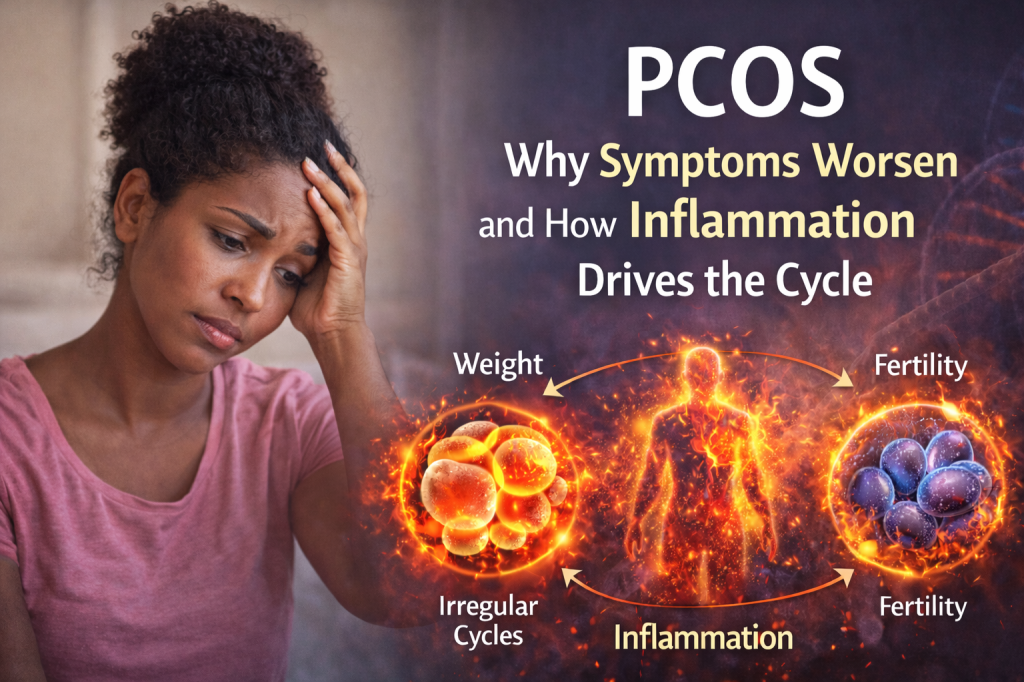
Polycystic Ovary Syndrome affects up to one in ten women worldwide. For many women, symptoms do not stay stable. Over time they often intensify. Weight becomes harder to manage. Cycles grow more unpredictable. Fatigue and brain fog increase. Fertility concerns appear. The common thread running through all of this is chronic inflammation.
Understanding this link changes everything.
What inflammation does inside PCOS
Inflammation refers to immune activity that stays switched on. In PCOS, inflammatory markers such as C-reactive protein, interleukin-6, and tumor necrosis factor alpha remain elevated. This immune overactivity disrupts hormone signaling, damages insulin sensitivity, and interferes with ovarian function.
Inflammation pushes the body into survival mode. Blood sugar control weakens. Cortisol rises. Hormonal feedback loops lose precision. Over time the entire metabolic system shifts toward imbalance.
The insulin resistance loop
Most women with PCOS show some degree of insulin resistance, even at a healthy body weight. Inflammation drives this process.
Inflammatory signals block insulin receptors. Glucose stays in the bloodstream longer. The pancreas releases more insulin. High insulin stimulates ovarian cells to produce more androgens such as testosterone. Androgens disrupt ovulation, increase abdominal fat storage, worsen acne and hair growth, and further increase inflammation.
This creates a self-reinforcing loop.
- Inflammation increases insulin resistance
- Insulin resistance increases androgen production.
- Androgens increase visceral fat
- Visceral fat releases more inflammatory chemicals.
Symptoms do not worsen randomly. They follow this biochemical chain reaction.
Why weight becomes stubborn
Fat tissue, especially around the abdomen, acts as an endocrine organ. It produces estrogen, cortisol, and inflammatory cytokines. In PCOS, this fat becomes metabolically active in harmful ways.
Inflammation slows mitochondrial energy production. Fewer calories convert into usable energy. The body shifts toward storage. Hunger hormones such as ghrelin rise while satiety hormones such as leptin lose sensitivity.
Weight gain becomes less about willpower and more about distorted signaling.
Cycle irregularity and ovulation disruption
Healthy ovulation requires precise communication between the brain, pituitary, ovaries, and uterus. Inflammation interferes with this signaling at multiple levels.
- Inflammation suppresses follicle stimulating hormone.
- Androgens block follicle maturation.
- Insulin excess alters ovarian enzyme activity.
- Cortisol disrupts progesterone balance.
The result is delayed ovulation, missed cycles, or cycles without ovulation. Over time, progesterone deficiency becomes common, worsening anxiety, sleep quality, fluid retention, and premenstrual symptoms.
Fertility challenges
Ovulation quality matters as much as ovulation frequency. Inflammatory chemicals impair egg development, reduce implantation success, and increase miscarriage risk.
Calming inflammation improves ovarian blood flow, mitochondrial function inside eggs, and uterine receptivity.
This explains why anti-inflammatory interventions consistently improve fertility outcomes in PCOS even before weight loss occurs.
Brain fog and fatigue
The brain responds directly to inflammatory signals. Cytokines cross the blood brain barrier and alter neurotransmitter production. Dopamine, serotonin, and acetylcholine decline. Cognitive clarity fades. Motivation drops. Fatigue deepens.
Many women interpret this as emotional weakness or stress. In reality, the brain reacts to immune chemistry.
Why PCOS symptoms require pattern awareness
PCOS symptoms rarely move in straight lines. Energy, appetite, cycles, cravings, mood, and inflammation fluctuate based on food choices, sleep quality, stress load, movement, and hormonal timing. Because these factors overlap, many women struggle to identify what is driving symptom flare ups.
Tracking brings clarity.
When you log food, blood sugar patterns, stress, sleep, energy, cycle signals, and body responses together, patterns begin to surface. You may notice cravings increase after poor sleep. Brain fog worsens during certain cycle phases. Inflammation improves when meals are more balanced. These connections are difficult to see without records.
The Rebalance40 Anti Inflammatory Tracker is designed to support this awareness. It allows you to log daily entries, update them at any time, and review both daily and weekly trends. Nothing you enter disappears. You can also download your records as a PDF or CSV to review progress over time.
If you want to understand what is driving your PCOS symptoms, you can explore the Rebalance40 Anti Inflammatory Tracker here.
How calming inflammation stabilizes PCOS
When inflammation falls, multiple systems recover together.
- Insulin sensitivity improves.
- Androgen levels decline.
- Ovulation regularity increases.
- Fat metabolism accelerates.
- Brain chemistry stabilizes.
The body does not need perfection. It needs consistent signals of safety.
Core strategies that reduce inflammation in PCOS
- Nutrient density over restriction
- Focus on minerals, omega-3 fats, phytonutrients, and fiber.
- Magnesium, zinc, selenium, and vitamin D play direct roles in insulin signaling and ovarian hormone balance.
Stable blood sugar
Avoid long fasting periods. Eat protein and fiber at each meal. Prevent large glucose swings.
Anti-inflammatory fats
Emphasize olive oil, avocado, walnuts, flax, chia, sardines, salmon.
Gut restoration
Fermented foods, diverse vegetables, and reduced ultra-processed foods restore the microbiome, lowering immune activation.
Stress modulation
Lower cortisol through sleep regularity, morning light exposure, walking, breathwork, and strength training.
Movement that improves insulin sensitivity
Strength training and steady walking outperform intense cardio for PCOS.
Why tracking supports long term PCOS stability
PCOS does not improve through restriction or short term fixes. It stabilises when inflammatory load decreases and the body receives consistent signals of safety.
Tracking allows you to see whether changes in food quality, meal timing, sleep, stress reduction, or movement are improving cycle regularity, energy, cravings, and mood. These improvements often occur gradually and are easy to miss without written records.
The Rebalance40 Anti Inflammatory Tracker supports this process by helping you notice trends rather than focusing on individual days. It is not a calorie tracker or a fitness app. It is a tool for understanding how inflammation responds to daily choices.
You can view the Rebalance40 Anti Inflammatory Tracker and meal plan options here.
Final thought
PCOS does not worsen because the body fails. Symptoms intensify because inflammation quietly builds beneath the surface.
When inflammation calms, the entire hormonal system regains coordination. This is where lasting stability begins.
 Rebalance40
Leave a comment